5 AI Essay Grader Tools That Actually Work
It’s hard to deny the fact that AI tools have changed the way teachers and students approach writing assignments. On the one hand, they have made the writing process less time-consuming and exhausting by offering quick answers to any question you may have while working on an essay. On the other hand, they have created an additional pressure for the academia to make sure the essays students submit are not AI-generated.
AI essay graders promise to simplify the process and handle the heavy lifting of initial assessment. The only problem remaining is that many of these tools have flaws and lack the nuance to evaluate creative or complex arguments. After testing numerous platforms, we’ve found five AI essay grading tools that deliver exactly what they promise and want to share the results with you.
#1 PlagiarismCheck Essay Grader
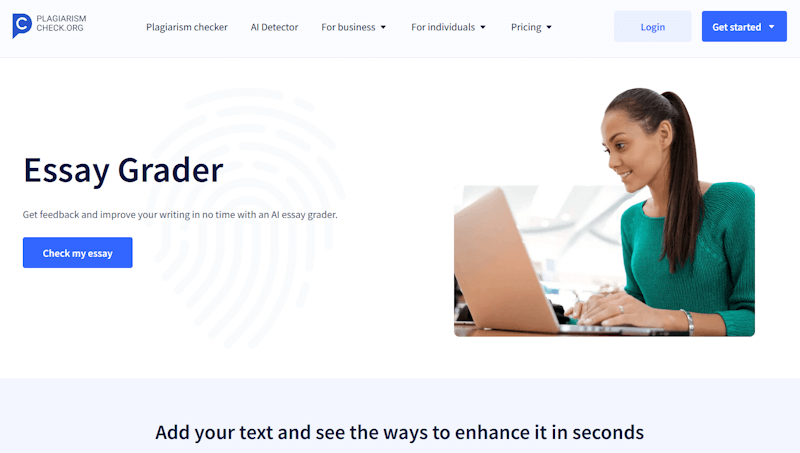
PlagiarismCheck essay grader offers a comprehensive solution that goes beyond simple scoring. After you’ve placed a “grade my essay” request, the platform analyzes grammar, structure, coherence, and argument strength of every literary piece. What makes this tool even more interesting is its integration with plagiarism detection, which means that you can verify originality while assessing quality using only one program.
The grader evaluates essays against standard academic criteria, and has a simple interface: upload an essay and receive results within seconds.
Pros:
- You can save a lot of time by using a single tool for grading and originality checks.
- Feedback is rather detailed and won’t confuse students.
- It’s possible to grade different essay types, from argumentative to analytical pieces.
Cons:
- Advanced customization options for rubrics are somewhat limited compared to specialized platforms.
- The tool works best with traditional academic essays rather than creative writing.
Best for:
Middle school through college-level academic essays, particularly useful for teachers who want built-in plagiarism detection without managing multiple platforms.
#2 Gradescope
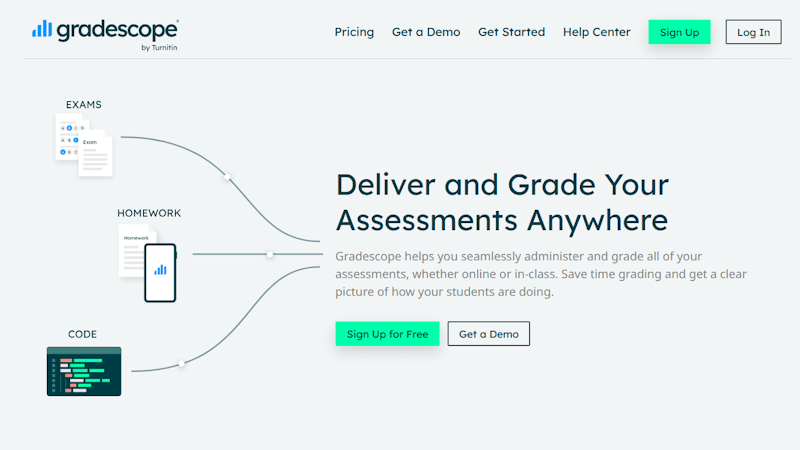
You might have heard about Gradescope being a platform for STEM assessments, but today you can also use its AI-assisted grading to handle essays as well. It uses a hybrid approach: teachers grade a few sample submissions, and the AI learns patterns to apply consistent standards across remaining submissions.
Key features
- Gradescope’s AI can scan through hundreds of submissions and group similar answers together. If ten students made the same structural error in their introductory paragraph, you can grade that group all at once and apply a single feedback comment to all of them.
- It’s easy to grade even handwritten essays with the help of Gradescope’s Optical Character Recognition.
Pros:
- Consistency with your specific grading standards.
- Excellent analytics that can show you class-wide trends.
- Strong integration with learning management systems like Canvas and Blackboard.
Cons:
- Requires manual grading of initial samples before AI assistance kicks in.
- Better suited for short answers than full essays.
- The interface can feel rather technical and not very intuitive.
Best for:
University professors or secondary teachers managing high volumes of students across multiple sections. Works particularly well for assignments with clear right and wrong elements alongside subjective components.
#3 EssayGrader.ai
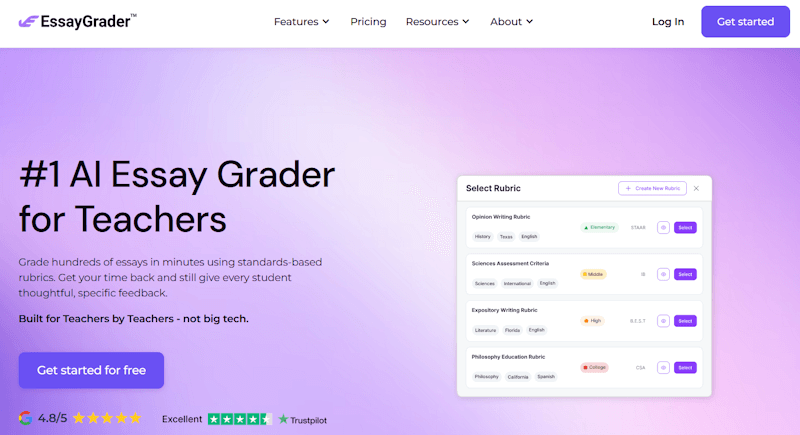
If your primary goal is to clear a mountain of grading in record time without losing accuracy, EssayGrader.ai is one of the most capable tools in 2026. The platform allows you to upload rubrics and even input specific focus areas for particular assignments. The AI then evaluates submitted essays against these parameters and generates detailed feedback.
Key features
- While many tools require you to open one essay at a time, with EssayGrader.ai, you can benefit from massive bulk uploads.
- You can upload your own specific rubrics or choose from a library of over 500 standards-aligned templates.
- Toggle between Concise, Medium, or Detailed feedback modes to give short pointers for weekly check-ins or deep analysis for final term papers.
The best part is that the system learns from your adjustments and becomes more accurate over time.
Pros:
- Has many customizations available to match specific assignment requirements.
- Has bulk grading feature that can process entire class at once.
- Generates feedback that sounds natural and personalized.
Cons:
- Requires initial setup time to train the system on your preferences.
- The quality of feedback depends significantly on how well you configure the tool.
- Occasional inconsistencies in grading similar essays.
Best for:
Teachers who want control over grading criteria and are willing to invest time upfront for long-term efficiency gains.
#4 Turnitin Revision Assistant
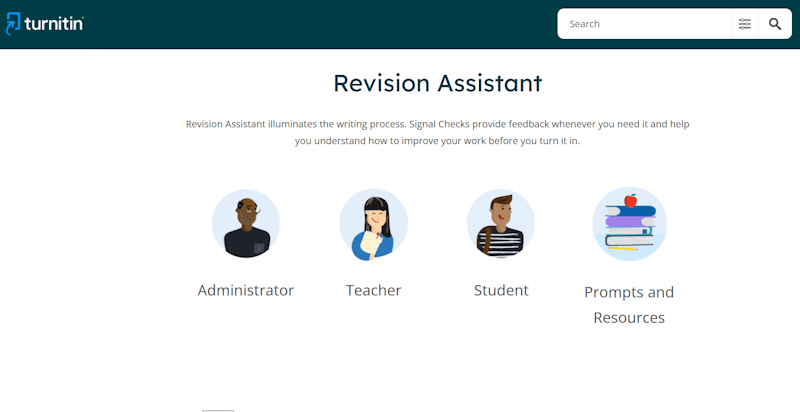
While most people know Turnitin for plagiarism detection, their Revision Assistant helps students before they turn in their work. It acts as a writing coach that reduces the teacher’s workload and catches common errors early.
Key features
- As students write, they can call for a Signal Check. The AI provides immediate ratings that look like Wi-Fi bars, showing the student how strong their work is in categories like evidence or clarity before they submit.
- Instead of just pointing out a mistake, it highlights specific sentences and provides relevant comments.
Turnitin uses natural language processing to determine specific strengths and weaknesses in student writing. Teachers can choose from pre-built rubrics or create custom ones aligned with specific learning objectives and state standards.
Pros:
- Seamless integration with existing Turnitin accounts.
- Strong emphasis on formative assessment encourages the revision process.
- Rubric customization allows alignment with specific curriculum standards.
Cons:
- Requires institutional licensing and makes it less accessible for individual teachers.
- The learning curve can be steep for both teachers and students initially.
- Pricing is generally higher than standalone tools.
Best for:
Educators focused on the process of writing who want students to engage in self-directed revisions.
#5 Grammarly for Education
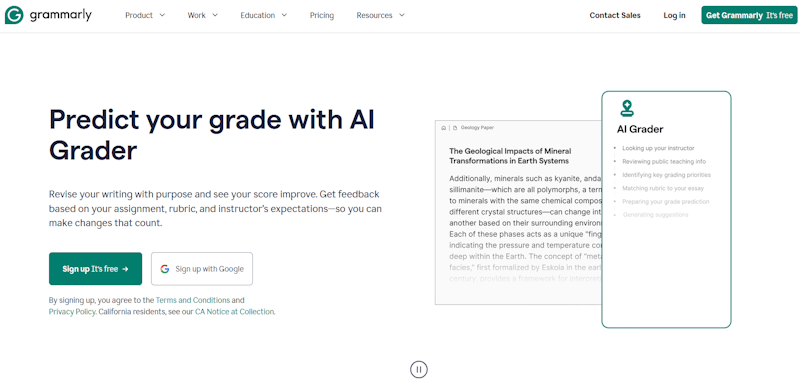
Grammarly’s educational platform extends beyond its well-known grammar checking and offers essay evaluation as well. The tool assesses writing quality, clarity, engagement, and delivery while providing real-time suggestions as students write.
The platform excels at identifying not just grammatical errors but also issues with tone and sentence variety. Its plagiarism checker scans against billions of web pages and academic databases. What makes Grammarly one of the best tools in this niche is the educational feedback loop: students see explanations for each suggestion and learn grammar rules as they revise.
Pros:
- Exceptional at teaching writing mechanics through detailed explanations.
- The browser extension allows students to receive feedback across multiple platforms.
- Premium features include vocabulary enhancement and genre-specific writing style checks.
Cons:
- While excellent for mechanics and clarity, it’s less versatile at evaluating thesis development compared to other tools with holistic essay assessment focus.
Best for:
Schools committed to improving student writing across all subjects, particularly effective for ESL students and those needing strong grammar support.
We all should remember that, as powerful as these tools are, they are most effective when used as a first draft of grading. Today, they can’t fully appreciate creative risks or the growth journey of students, but we don’t know what the future holds. Therefore, the most effective approach nowadays might be the combination of AI efficiency and human insight.

Comments (0)