How to Conduct a Content Gap Analysis and Actually Benefit from It
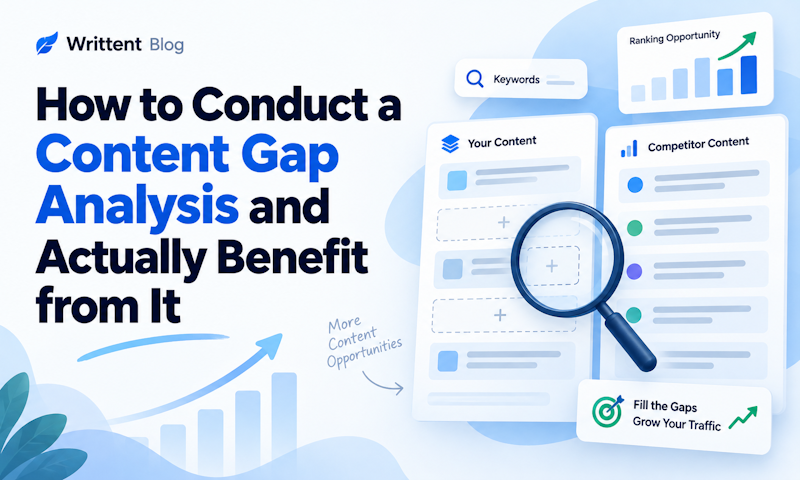
Hasn’t it often happened that you’ve spent hours putting together a blog post only to find it ending up on the fifth page of Google? That’s usually a symptom of a deeper issue. A content gap analysis shows you exactly what your audience is searching for and where your site is falling short. Rather than making guesses, you receive a clear, evidence-based strategy for the next piece to produce.
The guide covers each stage of the process, showing which tools can speed it up and how to turn the results into content that actually ranks.
What a Content Gap Analysis Actually Uncovers
At its heart, a content gap analysis looks at three things: the content you have produced, the content your competitors have produced, and the queries people enter into search engines. The gap is the difference between these three.
Gaps usually show up in a few forms:
- Missing topics. You don’t cover some topics, even though others in your field do.
- Lack of substance. Some articles are present but not extensive enough to satisfy readers or Google.
- Outdated pages. Articles that were accurate two years ago but are no longer.
- Wrong format. Instead of presenting it as a video or a calculator, offer the topic your audience wants.
Once you’ve identified what applies to your site, prioritize the necessary fixes rather than publishing randomly.
Why It’s Worth the Effort
Content marketing is now standard practice, but many teams still struggle to make it pay off. The main problem for most marketers is getting their articles to rank, and many don’t know where to allocate their budget and effort. Most people don’t lack content. They lack the right content for the right questions.
That is precisely what a content gap analysis resolves: it uses real search and competitor data, not guesses, to determine what is worth writing.
Step 1: Audit What You Already Have
Start by reviewing your website and listing all published URLs, along with their target keyword, word count, and current traffic – a spreadsheet works perfectly.
Look for any patterns – for example, which topics are frequently mentioned in customer questions yet have no full article assigned to them, and which previous posts just fail to make it into the top ten? That’s what topical authority mapping is: a snapshot of the subjects you already cover and those you only partly cover.
Step 2: Run SEO Research on Your Competitors
Once you’ve worked out your own material, look at the websites that are currently ranking higher than yours. This is where SEO research proves its value. Tools such as Ahrefs, SEMrush, or Ubersuggest reveal the keywords a competitor’s page ranks for and the traffic and backlinks it receives.
Pay attention to:
| What to check | Why it matters |
| Keywords they rank for that you don’t | Direct gap – an easy target |
| Text length and structure | Shows how deep you’ll need to go |
| Publish and update dates | Flags topics that reward freshness |
| Backlinks pointing to that URL | Signals how much authority it carries |
A single pass will often reveal a dozen realistic opportunities in a single afternoon.
Step 3: Use Web Scraping to Collect Data at Scale
Checking a few competing websites only takes you so far. If you want to carry out a truly thorough content gap analysis, then you should use web scraping – that is, retrieving the search results, headings, and metadata from hundreds of pages all at the same time. This is known as SERP data collection at scale, and it’s what distinguishes a quick look from a complete understanding of the market.
A few practical notes if you go this route:
- Most serious SEO platforms and competitor content audit tools make use of scraping as a matter of course, which means that you are probably already employing this method.
- An IP address can be blocked quickly, especially when you send a high volume of requests. To avoid this, many teams route crawlers through a proxy residential network, which spreads requests across real home IP addresses and helps data flow smoothly.
- Adhere to ethical scraping standards by respecting the robots.txt file, avoiding excessive requests to servers, and collecting only data that is publicly visible.
- Use rotating IP infrastructure for crawlers to get a more accurate picture of the results. Websites sometimes provide different content depending on who makes the request.
Step 4: Spot the Gaps and Prioritize Them
At this stage, you should have two lists: one of the items that you currently have and another of those that appear in the top-ranking results. Place them side by side, and the content gap analysis will be essentially complete.
Not every gap should receive the same level of attention, and a rapid priority analysis at this stage avoids a lot of wasted effort. Group them by:
- The number of searches and how closely the topic matches the audience’s intent.
- It seems very difficult to compete for that keyword.
- Whether it is linked to one of the things you have already ranked (it is easier to lift than if you started with a cold lift).
Step 5: Turn Findings into Briefs, Not Just a List
A spreadsheet showing the gaps is only useful when it becomes something a writer can act on. That is where content brief automation proves its value – through templates or tools that convert a keyword into a ready-to-use outline, with subheadings and questions to answer.
A good brief should also highlight what the top results overlooked. When based on the same on-page fundamentals that support general rankings, the process of writing is accelerated.
Don’t Treat It as a One-Time Project
Don’t carry out a content gap analysis once and then ignore it. Search intent changes, competitors publish new articles, and older posts begin to slip – a situation frequently referred to as content decay analysis. Pages that previously ranked well eventually lose their position.
A quick quarterly check will keep you ahead of these changes. You don’t have to carry out a complete re-run – just enough to pick up on positions that are slipping or new entries. Teams that monitor ranking behavior over time can detect these shifts before they result in actual traffic loss.
Common Mistakes Worth Avoiding
- Pursuing each and every keyword. In some cases, the topic will not convert with your audience even if the search volume is high.
- Skipping the audit stage and going straight to researching competing sites without first understanding your own text leads to redundant work.
- Viewing the tools as equivalent to the entire strategy. Although the software displays the data, you still have to decide which aspects matter.
- Failing to refresh existing articles. Sometimes the quickest win isn’t a new post, but improving one that is already there.
Bringing It All Together
This doesn’t have to take place all at once. A content gap analysis functions most effectively as a continuous practice – that is, you should carry out an audit, carry out some research, scrape the data, prioritize the items, prepare a briefing, publish the content, and then check back in a few months’ time. With each round, you better understand what your audience wants, and each subsequent cycle gets faster than the last.
Start small if you need to. Pick one competitor and one topic cluster, then work through the steps above. Once you see the pattern, it becomes second nature – a lot less like guesswork, and a lot more like a plan worth refining.

Comments (0)